
For travellers and tourists, rural environments can play a pivotal role in facilitating genuine connections with nature, fostering active participation in local customs and traditions. Rural inhabitants are inherently more in tune with their natural surroundings, putting them in a position to offer invaluable insights into local ecosystems and cultural heritage, and enriching the tourist experience (Van Wyk-Jacobs, 2018). Night-time activities generally have reduced competition for attention, and in rural contexts (Mitchell et al., 2019), provide the ideal setting for immersive cultural encounters under unpolluted dark skies.There is also a discernible shift away from niche astrotourism towards a more inclusive approach encompassing ecotourism and cultural tourism (Weaver, 2011). This evolution reflects tourists’ growing inclination towards meaningful experiences transcending mere scientific interest (Bjelajac et al., 2020). By broadening the tourism narrative, rural destinations can cater to a diverse range of travellers seeking authentic encounters with nature, culture, and the pursuit of existential significance. There is transformative potential in rural astrotourism products, positioning it as a compelling avenue for fulfilling the desires of travellers seeking profound connections and immersive experiences.
Astrotourism Pillars
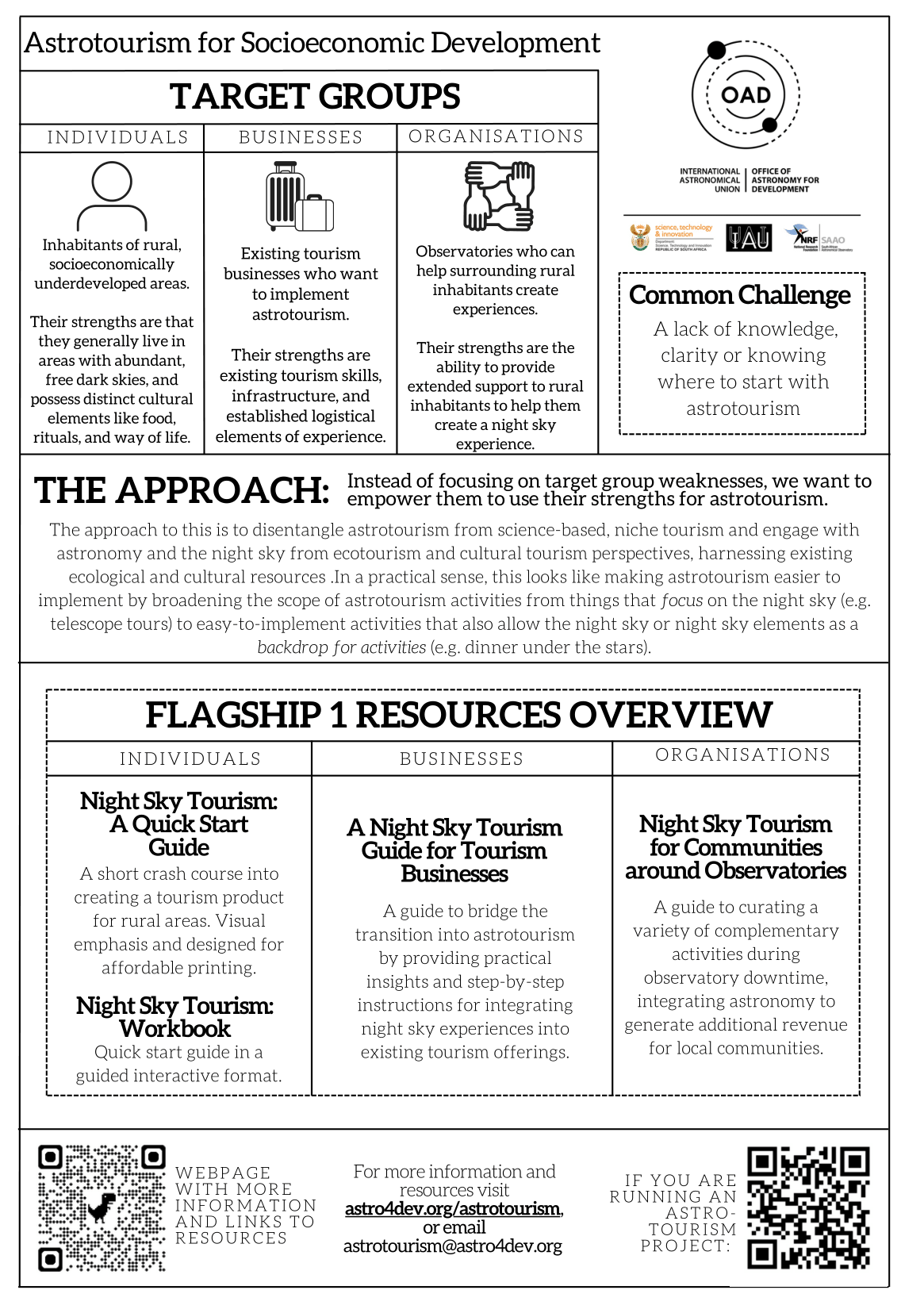
At the OAD, we promote and encourage astrotourism built on four interconnected pillars:
- Economic Development
- Cultural Preservation with Social Inclusion
- Environmental Sustainability
- Bridging inequality divides
This fourfold framework reflects our commitment to creating inclusive tourism ecosystems that uplift communities, protect the night sky, and celebrate cultural heritage.
Economic Development:
Astrotourism presents a powerful avenue for local income generation. Many astronomical facilities are located in remote areas rich in dark-sky assets but lacking economic opportunities. By supporting community-driven astro-experiences such as storytelling walks, astronomy festivals, and wellness retreats, this initiative promotes small business development, job creation, and long-term destination growth.
Cultural Preservation with Social Inclusion:
Astrotourism has deep cultural potential. It offers a platform to preserve, revitalise, and share Indigenous sky knowledge, traditional starlore, and celestial narratives. At the OAD, we place local communities at the heart of these efforts, ensuring they are not only beneficiaries but leaders in crafting experiences that reflect their heritage, voice, and aspirations.
Environmental Sustainability:
We advocate for responsible night-sky tourism that actively aims to address light pollution and safeguards natural ecosystems. Astrotourism encourages protection of dark-sky reserves and reinforces ecological stewardship by linking economic activity to environmental preservation.
Bridging inequality divides:
In a world that continues to be divided by a widening inequality gap, we try to use astrotourism to connect communities, families and individuals who lie on either side of this gap. By using the stars to drive a message of humility and humanity, it is hoped that apart from the usual one-way flow of revenue in conventional tourism, these initiatives will foster a greater appreciation and respect for one another, and potentially lead to unforeseen socio-economic outcomes on an individual basis.
References:
- Van Wyk-Jacobs, L. (2018) Astro-tourism as a Catalyst for Rural Route Development. dissertation.
- Mitchell, D. and Gallaway, T. (2019) ‘Dark sky tourism: Economic impacts on the Colorado Plateau Economy, USA’, Tourism Review, 74(4), pp. 930–942. doi:10.1108/tr-10-2018-0146.
- Weaver, D. (2011) ‘Celestial Ecotourism: New horizons in nature-based tourism’, Journal of Ecotourism, 10(1), pp. 38–45. doi:10.1080/14724040903576116.
- Bjelajac, D., Đerčan, B. and Kovačić, S. (2020) ‘Dark skies and dark screens as a precondition for Astronomy Tourism and general well-being’, Information Technology & Tourism, 23(1), pp. 19–43. doi:10.1007/s40558-020-00189-9.
- Blair, A. (2014) An exploration of the role the night sky plays in the lives of the Dark Sky island community of Sark. dissertation.
- A Design Manual for Astrotourism Experiences (no date). the International Astronomical Union’s European Regional Office of Astronomy for Development.